

Preparing a garage floor for epoxy
SRQ Garage Floors is a guide run by Terragroupe, LLC. We do not install anything and we are not booking jobs yet.
Prep decides how well a coating holds, and the first prep step is to find out how much moisture is in the slab. Clean the floor, read every crack and old coating layer, and test the concrete before anyone names a product. Use the same order when you talk to an installer.
SRQ Garage Floors is a guide run by Terragroupe, LLC. We do not install anything and we are not booking jobs yet.
Last reviewed October 18, 2026 against the cited sources.
Updated . Sources
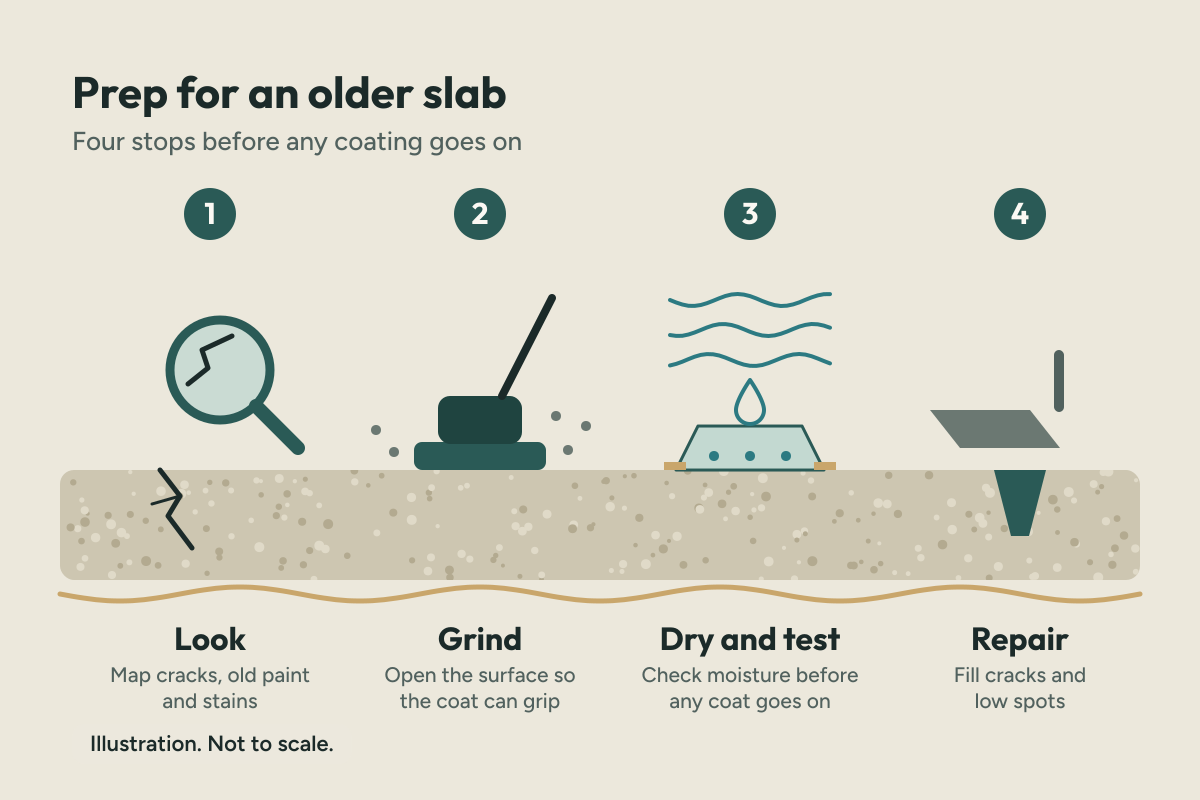
Start by reading the floor
- Old coating. Is it lifting, peeling or flaking? Photograph it. Sound old paint and failing old paint need different plans.
- Cracks. Mark them. A crack that keeps opening, or one side that sits higher than the other, may point to a slab problem. Ask a licensed professional about that.
- Stains. Oil and grease stains belong in the scope, because they are part of prep.
- Damp patches and low spots. Note where water sits.
Moisture: test, do not guess
Ground moisture can move up through slab-on-grade concrete, and Building Science names a plastic sheet directly under the slab as the recommended barrier 1. The same source argues that Florida slabs fare better than California's because of that practice 1. It is not a Florida failure rate, and it does not tell you what is under your slab.
So a surface that looks dry can still be a problem. Ask for a moisture test, ask for the method, and ask for the result in writing. We found no Florida figure for how often garage coatings fail from moisture, so we do not give one.
One epoxy data sheet (manufacturer, Canadian edition) names a limit: concrete moisture of 4% or less, read with a Tramex meter 2. Treat that as one maker's limit, not a rule for every system.
How the tests work
Some lab-style tests come up often. A federal guide specification for resinous floors cites the 2023 edition of F1869 and the 2019a edition of F2170 3. Ask your installer which one is in the scope.
- ASTM F1869, calcium chloride: a dish of calcium chloride sits under a plastic dome on the slab for 60 to 72 hours 4. The dish soaks up vapor coming out of the concrete. The result is in pounds per 1,000 sq ft 4.
- ASTM F2170, probes: holes are drilled and left to settle for at least 72 hours 4. Then probes read the humidity inside the slab, and the result is a percent relative humidity 4.
Where the limits come from
| Where it appears | The limit |
|---|---|
| Sikafloor-264 epoxy (Sept 2026) | 4 percent by mass on a Tramex meter, or 85 percent RH or less by F2170 5 |
| Sikafloor-511 polyaspartic (2023) | 4 percent or less on a Tramex meter 6 |
| Sikafloor-1620 primer, US (2025) | 6 percent by weight, or 96 percent RH by F2170 7 |
| Sikafloor-1620 Canada (2026) | Resists up to 25 pounds (F1869) and 100 percent RH (F2170) 8 |
| ARMPOLY85-CM topcoat | Substrate humidity under 4 percent 9 |
| Federal guide specification | The specifier picks 3 or 4.5 pounds, or 75 percent RH 3 |
Do not compare rows as one rule. The federal document leaves the choice to the specifier 3. We found no garage-market epoxy sheet that states a pound limit for the calcium chloride test. If a reading is high, a moisture-tolerant primer is a different, costlier step than a standard coat.
Ask for the test name, the sheet and limit it is measured against, and the written result.
Surface profile: grind, blast or etch
A coat needs a rough, clean surface to grip. Makers rate that roughness with the ICRI concrete surface profile scale, called CSP. KTA-Tator, a coatings inspection firm, says it runs from CSP 1, very smooth and typical of acid etching, to CSP 10, very rough and typical of jackhammering 10.
| Product or method | What it asks for |
|---|---|
| Sikafloor-264 epoxy | Mechanical prep to CSP 3 to 4 5 |
| Sikafloor-511 polyaspartic | CSP 3 to 4 6 |
| Sikafloor-1620 Canada | At least CSP 3 8 |
| ArmorPoly 80 (garage) | Grinding or acid etch on new concrete cured at least 30 days 11 |
| Acid etching, typically | CSP 1 10 |
Sika's prep guide calls shot blasting the industry standard. It says diamond grinding creates a profile, and that polishing pads of hard aggregates such as aluminum oxide do not 12.
The sources do not agree on the minimum. Our reading is that etching alone sits at CSP 1, below the CSP 3 to 4 on the Sika sheets 10 5. The ArmorPoly 80 sheet names no CSP number 11. We did not read the ICRI table that pairs each method with a CSP number, so the CSP 1 figure rests on one inspection firm's page 10.
Ask which method and which CSP your scope names, and which sheet that number comes from.
Weather on the day
Makers set limits for the day of the job. One polyaspartic data sheet (a vendor source) asks the slab to stay at least 5 F above the dew point and the air to stay at or under 75% humidity during application and cure 13. Epoxy sheets set their own limits. Sarasota's numbers are on the epoxy and polyaspartic pages. The storm and moisture guide shows which months leave the most room.
Cure time matters too. At 68 F the polyaspartic sheet lists about 4 hours to foot traffic, about 8 hours to light traffic and about 5 days to full cure 13. Other systems differ, so get the cure time for your system in writing.
What a written scope should name
- How the floor will be cleaned and degreased.
- The prep method and the surface profile, by CSP number.
- How cracks and damaged spots will be repaired.
- The moisture test by name, who runs it, the sheet's limit and what result stops the job.
- The system and the number of coats.
- The cure time before cars go back in.
- The price and what it covers.
- The warranty exclusions, in writing.
Price it first with the Garage Floor Price Estimator.
Facts used in this guide
| Fact | Value | Source |
|---|---|---|
| Polyaspartic topcoat data sheet requires substrate at least 5 F above dew point and max ambient RH of 75% during application and curing. | 5 F margin; RH <= 75 F / percent RH | [13] June 10, 2021 |
| Epoxy smooth-finish coating data sheet: max RH 85% during application and cure; substrate at least 5 F (3 C) above dew point; substrate 50-86 F; concrete moisture <= 4% by Tramex meter; no vehicle load until fully cured. | RH <= 85; moisture <= 4; substrate 50-86 percent RH / percent by mass / F | [2] 2026-06 |
| Polyaspartic topcoat at 68 F: foot traffic ~4 h, light traffic ~8 h, full cure ~5 days; marketed for enhanced hot-tire-marking resistance and excellent UV resistance. | 4 h / 8 h / 5 days hours / days | [13] June 10, 2021 |
| Garage-market polyaspartic base coat data sheet: apply 30-90 F, tack-free 2-4 h, vehicles after 24 h at 72 F / 50% RH, recoat 2-12 h, UV stable. | vehicles 24 h hours | [14] 2025 (Version 1; Rev 11/21) |
| Ground moisture can move up through slab-on-grade concrete; a plastic sheet directly under the slab is the recommended barrier, and Building Science argues Florida slabs fare better than California's because of that practice. | n/a | [1] May 26, 2008 |
Garage Floor Price Estimator
Type your garage size in square feet, or find it in the table below. The estimate is national, it is not a quote, and it leaves out heavy prep.
Start the Garage Floor Price EstimatorSRQ Garage Floors is a guide run by Terragroupe, LLC. We do not install anything and we are not booking jobs yet.
Questions people ask
Why does an epoxy garage floor peel?
People point to moisture coming up through the slab, poor prep and a weak old layer under the new coat. We found no Florida failure rate, so we cannot say which cause is most common. A moisture test and a close look at the old layer are the way to rule them out.
Can I put epoxy over old paint?
It depends on the paint. Sound paint and failing paint need different plans, and the installer should say which you have and how they will handle it. Take photos of the paint, so you can show them to any installer.
How long before I can park on a new coating?
It depends on the system. One polyaspartic data sheet lists about 5 days to full cure at 68 F 13. Ask for the cure time for your system in writing.
Is acid etching enough before epoxy?
The Sika sheets we read ask for a profile of CSP 3 to 4 5. Acid etching is typically CSP 1 10. One garage polyaspartic sheet accepts grinding or acid etch on new concrete 11. Ask which method and profile your scope names.
Which moisture test should my installer use?
The two common tests are a calcium chloride dish under a dome (F1869) and probes in drilled holes (F2170) 4. Which limit applies depends on the product sheet. Ask for the test, the limit and the result in writing.
Sources
- Building Science Corporation, BSI-003: Concrete Floor Problems, May 26, 2008
- Sikafloor-261 CA product data sheet (manufacturer, Canadian edition), 2026-06
- UFGS 09 67 23.13 Standard Resinous Flooring (USACE/NAVFAC/AFCEC, references per UMRL July 2026), 2019-11
- Test Methods in Concrete (Sika USA), August 23, 2019
- Sikafloor-264 product data sheet (Sika USA, September 2026, vendor), 2026-09
- Sikafloor-511 product data sheet (Sika USA, June 2023, vendor), 2023-06
- Sikafloor-1620 product data sheet (Sika USA, March 2025, vendor), 2025-03
- Sikafloor-1620 product data sheet (Sika Canada, June 2026, vendor), 2026-06
- ARMPOLY85-CM technical data sheet (ArmorPoxy, vendor), 2024-04
- Measuring the Surface Profile of Prepared Concrete (KTA-Tator), July 18, 2019
- ARMPOLY80-RM technical data sheet and instructions (ArmorPoxy, vendor), May 30, 2025
- Surface Preparation Guide (Sika USA, vendor; page undated, read 2026-10-18), October 18, 2026
- Sika, Sikafloor-515 product data sheet (vendor), June 10, 2021
- ArmorGarage Polyaspartic Floor System TDS (ArmorPoly 80), 2025 (Version 1; Rev 11/21)